



250 Years. 12 Stories. One County.
A county’s history isn’t found only in books, archives, or museum collections. Sometimes, it’s standing right in front of us.
It’s in the brick walls of a market house that has welcomed generations of shoppers. In the iron framework of a bridge built when horses and wagons traveled the roads. And in the winding paths of a cemetery designed as carefully as any public park.
Across Crawford County, these structures and landscapes reveal how a growing nation took shape at the local level. In the decades following American independence, advances in transportation, commerce, and community planning transformed towns across Pennsylvania. The buildings, bridges, and public spaces that emerged during this period reflect the ingenuity, craftsmanship, and ambitions of the people who helped build the America we know today.
The Meadville Market House: A Building That Became a Tradition
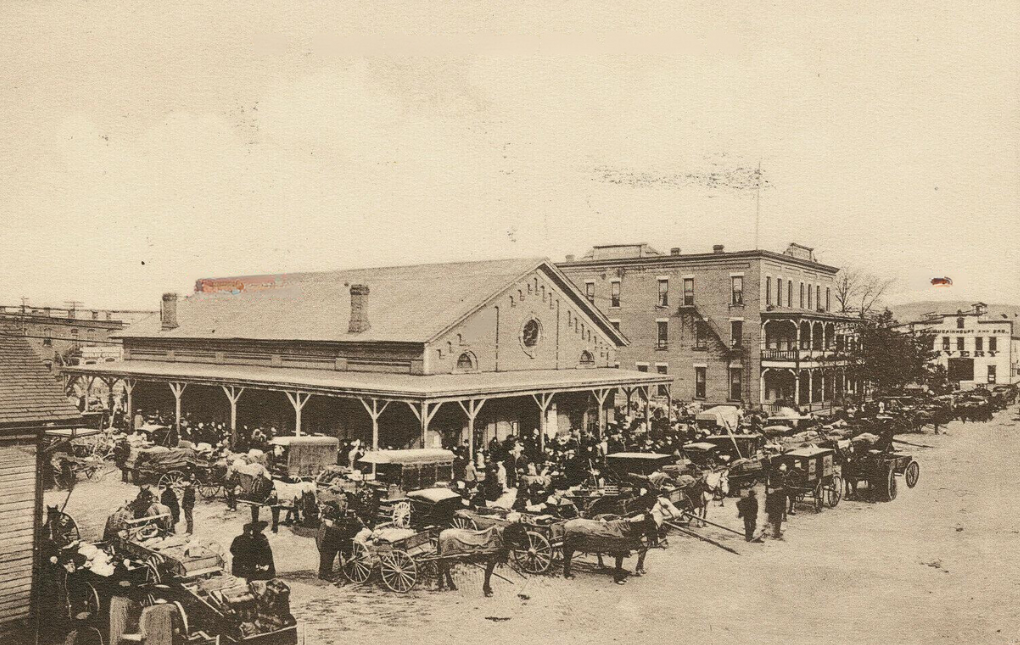
When the Meadville Market House was built in 1870, the city was experiencing a period of growth and transformation. Railroads had expanded opportunities for commerce, businesses were taking root, and the community needed a central location where farmers, merchants, and residents could come together.
The Market House provided exactly that.
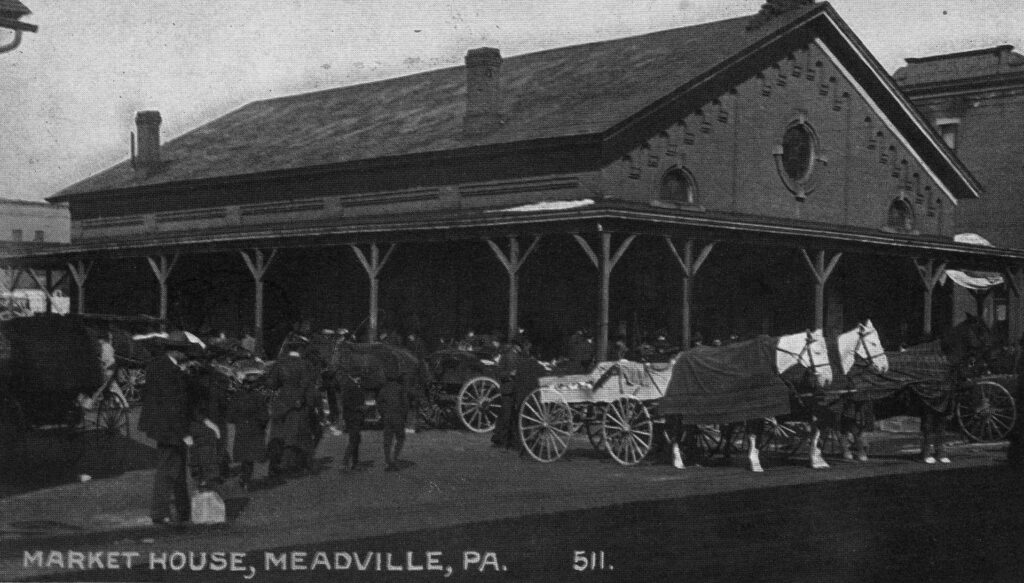
Built as a permanent home for local commerce, the brick structure brought farmers and craftspeople together under one roof. Its simple rectangular design featured a gabled roof and open-air galleries along all four sides, providing sheltered space for people to gather, shop, and exchange goods. The market became a gathering place where the surrounding agricultural community connected directly with the growing city.
Today, it holds the distinction of being Pennsylvania’s oldest continuously operating market house, a remarkable achievement considering how much shopping and commerce have changed since the 19th century.
But the Market House hasn’t remained unchanged. A second story was added in 1916–1917, expanding the building’s usefulness beyond its original purpose. Since 1975, the upper floor has housed the Meadville Council on the Arts, bringing exhibitions and performances into a building already central to the community’s identity.
Its survival wasn’t guaranteed, either. By 1970, the Market House faced an uncertain future, and a community effort helped save it. Rather than allowing the historic structure to disappear, residents recognized the value of preserving a place that remained useful to everyday life.
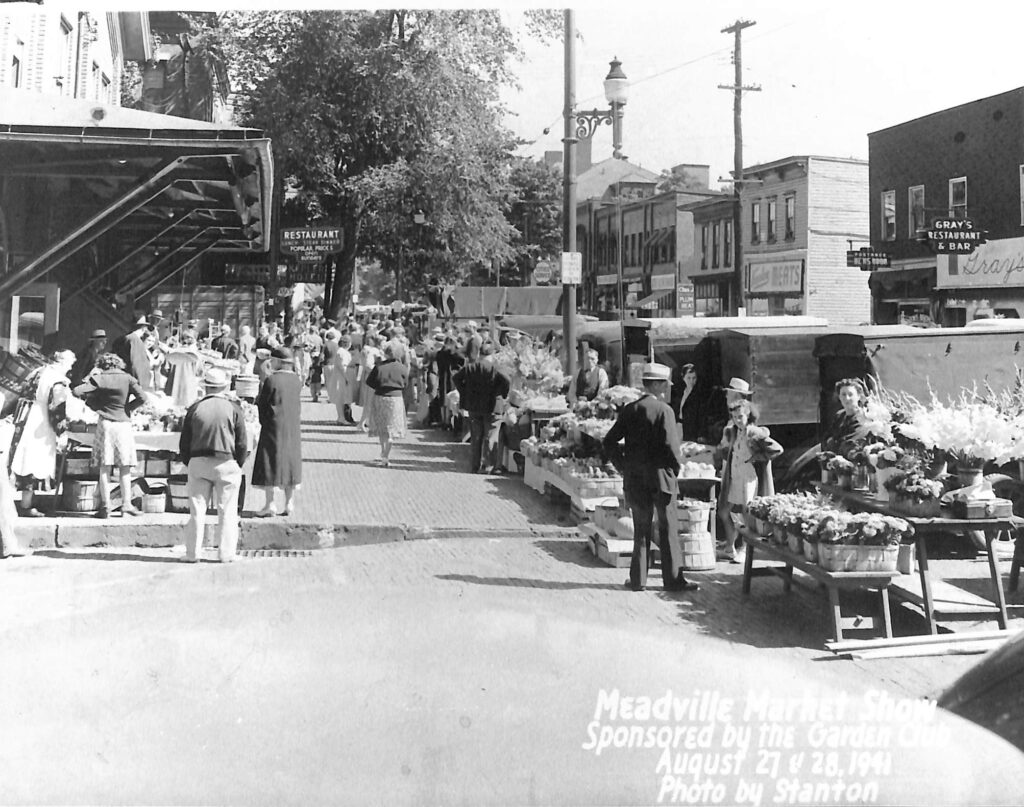
More than 150 years after opening, the Market House continues to connect local producers and customers. Shoppers can still find locally grown foods, baked goods, specialty products, and handmade items, while its architecture provides a tangible connection to the Meadville of another century.
The building’s significance goes beyond its age. It demonstrates how thoughtful architecture can serve a community across generations, adapting to changing needs without losing its original purpose.


Engineering Across the Landscape: The Bridges of Crawford County
Before modern highways and concrete bridges, crossing the waterways of Crawford County presented a serious engineering challenge.
French Creek and its tributaries shaped the region’s settlement and commerce, but they also created obstacles for people transporting agricultural products, timber, manufactured goods, and other materials. As communities expanded during the 19th century, dependable bridges became essential connections between farms, towns, and emerging industries.
The development of iron bridge construction helped transform those connections.
Earlier bridges relied heavily on timber, but advances in metalworking made it possible to construct stronger, more standardized spans. Bridge companies began manufacturing iron components that could be transported to a site and assembled, reducing construction time while allowing roads to cross waterways more efficiently.
Crawford County became home to a remarkable surviving example of this evolving technology: the Messerall Road Bridge near Titusville.
The Remarkable Second Life of the Messerall Road Bridge
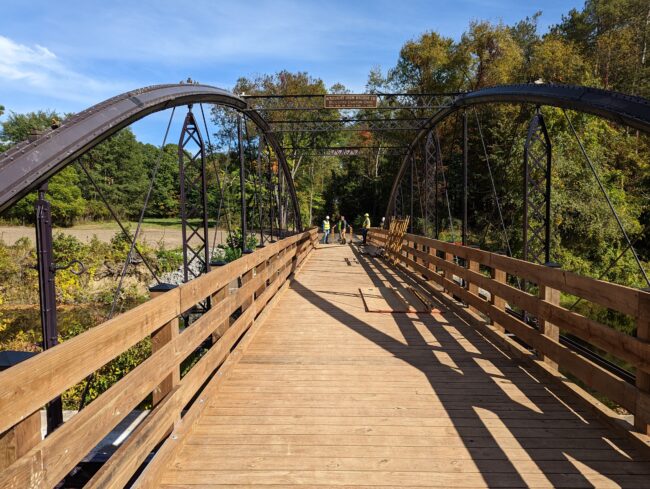
Constructed in 1876 by the Wrought Iron Bridge Company of Canton, Ohio, the Messerall Road Bridge originally crossed Pine Creek near East Titusville. Its distinctive bowstring through-truss design featured a curved upper structure resembling an archer’s bow, with an arrangement of iron members that distributed the weight of the crossing across the span.
The bridge was a practical example of 19th-century innovation. Its prefabricated components made transportation and assembly more efficient, an important advantage in a region where expanding oil and lumber industries depended on reliable infrastructure.
Although thousands of metal truss bridges were constructed across the country during this era, relatively few early bowstring examples survive. The Messerall Bridge is considered a particularly significant example of early wrought-iron bridge engineering in Pennsylvania.
The bridge endured for more than a century before deterioration led to its closure in 1987. For decades, the historic structure remained out of service, its future uncertain.
Then came an opportunity to preserve it through an entirely new purpose.
In August 2021, the bridge was carefully removed from its original location and transported to a blacksmith shop for restoration. Craftspeople repaired its historic ironwork, preserving the distinctive engineering that had made it valuable in the first place. In September 2022, the bridge was reassembled over Linesville Creek as part of an expansion of the Pymatuning State Park trail system.
The project extended the trail from just over one mile to more than three miles, improving connections between the park and the Linesville community. It also gave the historic bridge a second life.
The preservation effort earned recognition in 2023 when the Pymatuning State Park Trail Extension Project received a Project of the Year award from the Franklin chapter of the American Society of Highway Engineers.
Today, the same iron framework that once supported travel and commerce near Titusville provides a crossing for people exploring the trails near Linesville.
Its story is particularly meaningful because preservation did not simply mean protecting an old structure from further deterioration. It meant giving that structure a new role in the community.
A bridge built to meet the transportation needs of the 1870s has become part of Crawford County’s modern recreational infrastructure, connecting two very different eras of local life.
Greendale Cemetery: Where Landscape Design and History Meet
Not every important example of 19th-century design was built from brick or iron. Some of the era’s most thoughtful achievements were created by shaping the natural landscape itself.
During the 1800s, a movement toward rural cemetery design began changing the way Americans thought about burial grounds. Rather than arranging graves in small, crowded plots near churches and town centers, planners envisioned larger, landscaped spaces with winding paths, trees, gardens, and monuments.
These cemeteries were designed as places of remembrance, but they also provided peaceful settings where people could walk, reflect, and appreciate the natural environment.
Greendale Cemetery in Meadville is an outstanding local example of this philosophy.

A Landscape Designed to Endure
Greendale’s origins date to Meadville’s earliest years, when the community maintained a burial ground near what is now Randolph Street and Park Avenue. As the town grew, the original cemetery became increasingly inadequate, prompting the establishment of a new burial ground in 1852.
Creating Greendale required more than setting aside land for burial.
Beginning in 1854, the cemetery’s first superintendent, Herman Leo, helped transform the property’s rolling hills into a carefully planned landscape. An engineer by training, Leo laid out burial plots, roads, and walking paths that followed the natural contours of the terrain.
Instead of imposing a rigid grid across the property, the design incorporated winding, park-like drives among the sloping hills, offering visitors changing views of the grounds. The approach reflected a growing national movement that viewed cemeteries as places of natural beauty, peaceful reflection, and public enjoyment.
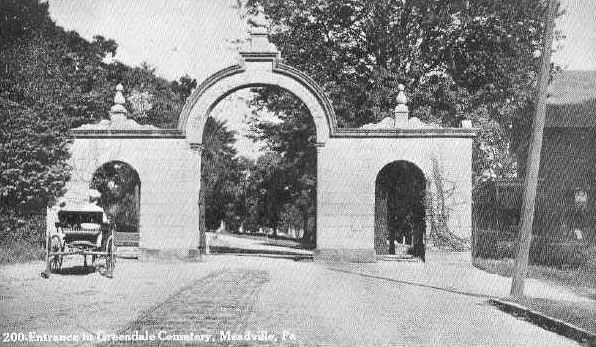
The landscape continued to evolve. In 1865, an imposing stone archway was constructed at the cemetery entrance, creating a distinctive architectural landmark that still welcomes visitors today.
A decade later, in 1875, horticulturist Herman Munz was appointed superintendent and began introducing ornamental trees and flowering shrubs that would become defining features of Greendale’s landscape.
His work helped establish the cemetery’s celebrated collection of rhododendrons, which remains one of its most recognizable features. Today, more than 1,500 rhododendrons grow within the cemetery, creating an extraordinary seasonal display that draws visitors to the grounds.
Beyond the flowering shrubs, Greendale contains mature hardwoods, ancient hemlocks, scenic walking paths, and a deep wooded ravine. Its natural features and carefully planned landscape demonstrate how 19th-century design principles continue to influence the appearance and character of a place more than 170 years later.
The monuments themselves reveal another dimension of the cemetery’s history. Their materials, craftsmanship, and decorative details reflect changing artistic styles and the ways families chose to commemorate loved ones across generations.
Greendale is more than a collection of historic graves. It is a cultural landscape where architecture, horticulture, engineering, and community memory intersect.
Its continued preservation demonstrates that thoughtful design can create places that remain meaningful long after their original planners are gone.



Why These Places Matter for America 250
When we think about the progress of a nation, it’s easy to focus on dramatic inventions, major historical events, or the industries that transformed the economy. Yet much of what makes a community successful depends on the everyday places and infrastructure that connect people.
In Crawford County, the Meadville Market House strengthened the relationship between agriculture and commerce. Iron bridges opened transportation routes that supported expanding industries and growing communities. Greendale Cemetery reflected changing ideas about public landscapes, nature, and how communities honor their past.
Each represents a different form of innovation, but they share something important: they were created to meet the needs and aspirations of the people who lived here.
Their continued presence also tells another story, one about preservation.
A historic building can be adapted to serve new generations. An abandoned bridge can become part of a recreational trail. A carefully designed landscape can remain a place of natural beauty and remembrance more than a century after its creation.
As America commemorates its 250th anniversary, these places offer a reminder that the nation’s story extends beyond its founding. It is also the story of the communities that grew, the infrastructure that connected them, and the decisions that allow their history to remain part of everyday life.
Experience the History Today
You don’t have to be an architect or historian to appreciate Crawford County’s built heritage. These places remain accessible parts of the landscape, offering opportunities to experience history beyond museum walls.
Shop at the Meadville Market House. Browse locally produced foods, specialty items, and handmade goods in a building that has served the community since 1870. Take a moment to appreciate its brick architecture and the open-air galleries that have welcomed generations of shoppers.
Cross the restored Messerall Road Bridge. Explore the Pymatuning State Park Spillway Trail near Linesville, where a remarkable example of 19th-century engineering has found a new purpose as part of a modern recreational trail.
Discover the grounds of Greendale Cemetery. Walk its winding paths, admire the historic stone entrance, and experience a landscape shaped by generations of horticultural care. The annual rhododendron blooms offer a particularly beautiful opportunity to appreciate the cemetery’s design.
Look a little closer at Crawford County’s historic downtowns. From decorative brickwork and distinctive storefronts to the public buildings that have anchored communities for generations, architectural history can be found throughout the county.
Some of Crawford County’s most remarkable history is hiding in plain sight. It’s in the ironwork of a bridge, the brick walls of a market house, and the thoughtfully designed landscape of a historic cemetery. These places have witnessed generations of change, yet they continue to serve, inspire, and connect the communities around them.
They’re reminders that history isn’t simply something left behind. It’s something we continue to build upon.